
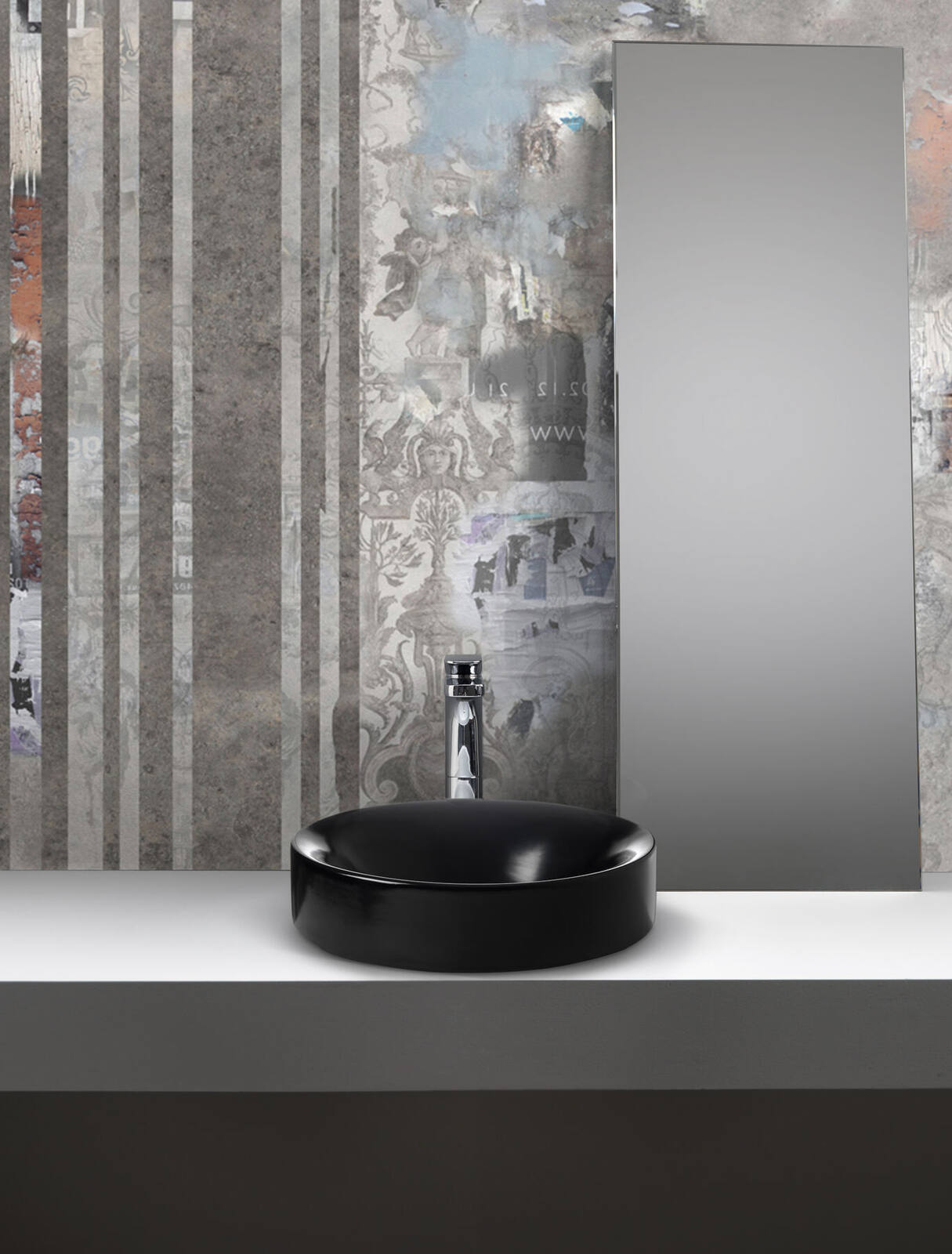
Choose a basin by working back from the tap and the wall. A vessel basin needs a tall mixer or a wall-mounted spout and a lower worktop. A wall-hung basin needs solid fixing and leaves its trap on show. An inset or semi-recessed basin needs a worktop or cabinet cut to suit. A freestanding or console basin brings its own support but fixes the height. Once you know which tap you want, where the waste runs and how deep the room is, the right type of basin is usually obvious.
The six types of bathroom basin
Vessel basins
A vessel or countertop basin sits on top of a worktop or unit, with only the waste passing through. It reads as an object in its own right, which is why sculpted forms and coloured glazes suit it. Our Brett basins come with ceramic pedestals; Ore is offered in a wide range of gloss and matt glazes, with a lower version, Ore Low.
Wall-hung basins
A wall-hung basin is bolted straight to the wall, leaving the floor clear beneath. The wall must take the load: in a stud partition, fit a timber pattress or a basin frame before boarding. The trap is visible, so it should be a bottle trap in a finish that matches the tap.
Inset and semi-recessed basins
An inset basin drops into a hole in the worktop, with its rim resting on the surface. A semi-recessed basin sits partly into the top of a cabinet, with its front edge projecting beyond it. That lets you use a shallower cabinet, which helps in a narrow room. Our Gipping basins are semi-recessed and paired with wall cabinets.
Freestanding and console basins
A freestanding basin rises from the floor as a single piece, with the waste and often the supplies hidden inside. It needs pipes brought up through the floor in exactly the right place, set out before the floor is laid. A console basin sits on legs or a metal frame, sometimes with a towel rail, and leaves the plumbing partly visible. Debenham includes a freestanding basin; Alde offers brass and steel washstands.
Tap choice and spout reach
The water should land near the waste. Too short a spout and it hits the back of the bowl and splashes; too long and it lands on the front rim. Check the spout reach on the tap drawing against the distance from the tap position to the centre of the waste on the basin drawing.
Match the tap to the tap holes. Basins come with no tap hole, one or three, and a one-hole basin will not take a three-hole mixer. Vessel basins usually have no hole, so they take a tall deck mixer on the worktop or a wall-mounted spout. Wall-mounted taps have a body built into the wall, which has to be set at the correct depth at first fix and cannot easily be moved. All taps have a minimum working pressure; check it against your water system, particularly in an older house on a gravity supply. Our full range is under taps and mixers.
Overflows and wastes
A basin with an overflow takes a slotted waste, so water rising into the overflow can drain through the slots. A basin without an overflow takes an unslotted waste. Many vessel and sculpted basins have no overflow, because the form does not allow one.
That affects the choice of waste. A sprung or click-clack plug can be closed on a basin with no overflow, and if a tap is left running the basin will flood. In a guest cloakroom, or a house with young children, a free-flowing waste that cannot be closed is the safer choice on a basin without an overflow.
Getting the height right
What matters is the height of the rim, not the height of the worktop. A vessel basin adds its own height to the top it sits on, so the worktop or unit must be lower than it would be for an inset basin. A pedestal or freestanding basin has its height fixed by the ceramic. A wall-hung or semi-recessed basin can be set wherever suits the people using it.
Agree the rim height on site with the household, and mark it on the wall before first fix. Plumbers tend to set basins at the height they are used to, and that is not always right for a tall family or a children’s bathroom.
Cloakroom basins and principal bathroom basins
A cloakroom basin is for washing hands, often in a room where the door swing and the WC leave little space. Projection from the wall matters more than width. A small wall-hung basin, a corner basin or a compact vessel on a narrow shelf will usually work; Alde starts with a 35cm round basin. A cloakroom is also a good place for a basin with real character, such as one of the three sculpted Cretingham basins: Cocktail, Flute and Hurricane.
A principal bathroom basin works harder. It needs space for shaving and teeth, somewhere to put things down, and storage below or beside it. Where two people get ready at the same time, a double basin earns its place: Alde goes up to a 140cm double and Thornham to a 150cm double. Vanity units, cabinets and panelling can be made to measure in our joinery workshop to sit with the ceramics.
Cleaning and worktop materials
A vessel basin needs wiping around its base and behind it, where it meets the worktop. An inset basin has a sealed joint around its rim. A semi-recessed basin has a joint at the cabinet top. Wall-hung and freestanding basins have the fewest joints of all. Matt glazes show water marks differently from gloss and benefit from regular drying; some pieces are available in an easy-clean glaze. Our care guide covers cleaning for each finish.
Timber tops need every face sealed, including the cut edge of the basin hole, and splashes wiped away rather than left to stand. Honed and polished natural stone both need sealing, and some stones are marked by acidic cleaners and cosmetics. Engineered and sintered surfaces are less demanding, though cut-outs still need careful finishing. Whatever the material, the top must be supported properly under a heavy vessel basin, and the waste hole and tap hole positions set from the actual basin and tap.
Have the basin on site before the worktop is templated. A cut-out made from a drawing rather than the basin itself is an expensive mistake to put right in stone.