
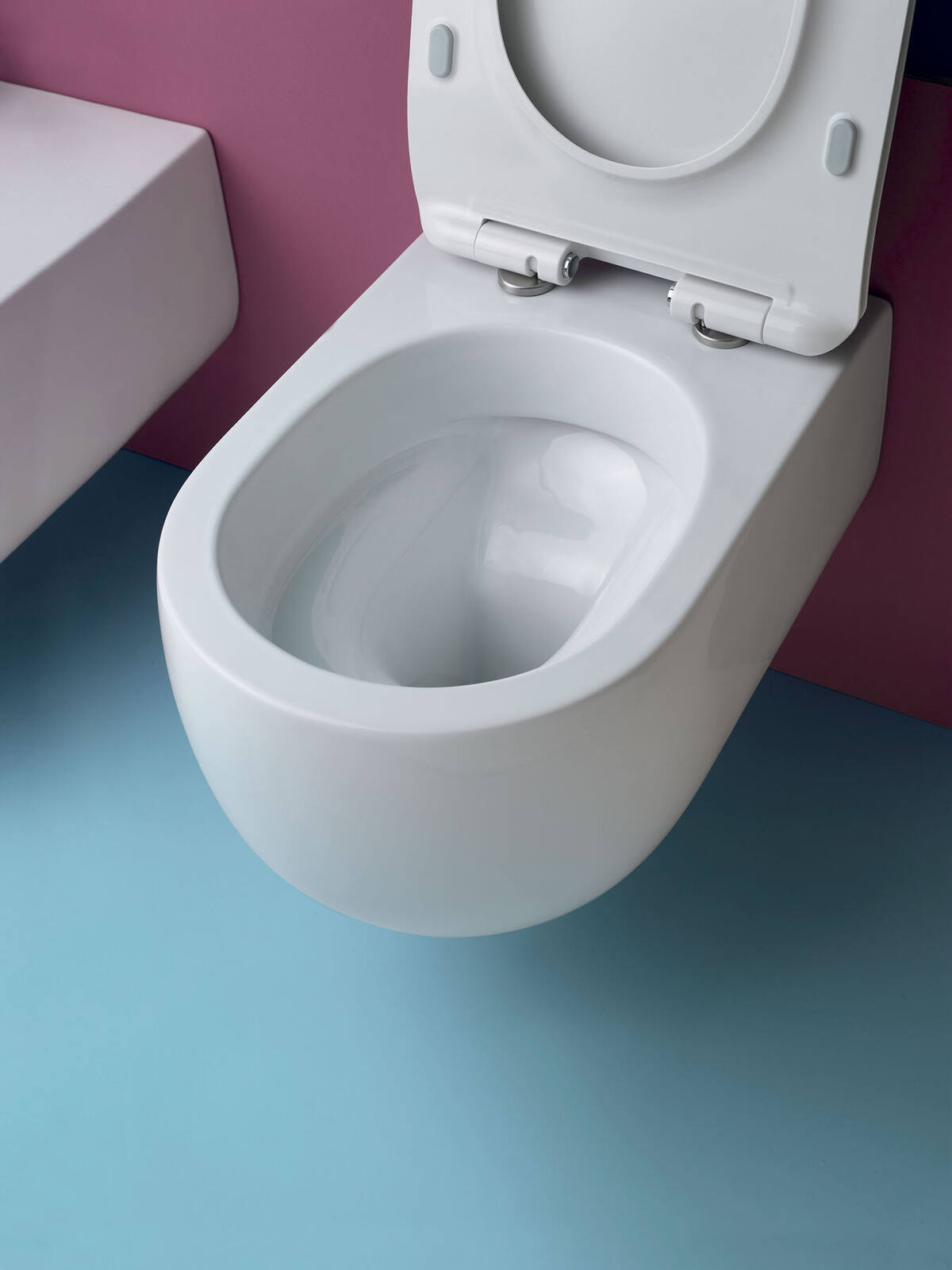
Matt and coloured sanitaryware is practical for everyday use, provided you clean it differently from white gloss. A matt glaze has a fine surface texture that holds marks a little more readily, so it needs a soft cloth and mild detergent rather than scouring, and in a hard water area it needs drying. A coloured glaze shows limescale and soap residue more than white does, especially in darker colours. Choose the colour against real samples of your tiles, stone and paintwork, in the room’s own light, and the result will hold up for as long as any white suite.
How matt glazes differ from gloss
Both are vitreous glazes fired onto the ceramic body, and both are waterproof and hygienic. The difference is the surface. A gloss glaze melts to a smooth, glassy finish that reflects light and sheds water easily. A matt glaze has a microscopically uneven surface that scatters light, which gives the soft, stone-like look people choose it for.
That surface affects daily cleaning in three ways. Water and soap dry as a visible film rather than running off. Metal can leave grey marks: a ring knocked against a basin edge, or a pan put down in a matt kitchen or utility sink, may leave a line that looks like a scratch but is metal transferred onto the glaze. And abrasive cleaners, which a gloss glaze will usually shrug off, can polish a matt surface unevenly so that one patch becomes shinier than the rest.
Daily and weekly cleaning
Rinse the basin after use and wipe it with a soft cloth. Once a week, wash it with warm water and a little mild washing-up liquid, rinse, and dry. Metal marks on a matt glaze usually lift with a damp melamine sponge used lightly; test it on a hidden area first. Avoid scouring powders, cream cleaners, wire wool and bleach left to sit on the surface. Our care guide sets out what to use on each glaze.
Choosing a colour against tiles, stone and joinery
A coloured basin, bath or WC is a fixed decision in a way a wall colour is not, so it pays to choose it against the materials it will sit beside. Many pieces in our ranges come in coloured and matt glazes such as matt black, matt green, matt hazel, matt grey, matt burgundy and matt brown. The Ore vessel basins come in a particularly wide range of gloss and matt glazes, including the shallower Ore Low.
Start with the largest surface in the room, usually the floor or the wall tiles, and work towards the smallest. A matt hazel or brown basin can look warm against limestone and oak, and muddy against a cool grey marble. Matt green sits easily with painted panelling but can clash with a green tile that is close in tone but not the same. Where colours are near each other, a clear contrast generally reads better than an almost-match.
Joinery is the easiest element to adjust. Because our joinery workshop makes vanity units, cabinets and panelling to measure, the paint colour on the furniture can be chosen after the ceramics are settled, so the basin is never forced to match a paint colour picked first.
Sampling a coloured glaze properly
Glaze colours change with light far more than paint does. A matt grey that looks neutral in a showroom can look blue in a north-facing bathroom and warm under a low-colour-temperature lamp. Look at any glaze in daylight and under the light fittings you intend to use.
Bring samples of your tiles, stone, paint and timber to the showroom at Mickfield and lay them against the actual pieces. If you cannot visit, ask for a glaze sample where one is available and look at it in the room at different times of day. Fired glazes also vary slightly from one firing to the next, so a basin and a WC in the same colour should be ordered together rather than months apart. If an item is replaced later, mention the original colour and order date so the closest match can be found.
Why a white interior inside a coloured basin can help
Some vessel and countertop basins are made with a coloured outside and a white glazed bowl. For a basin used every day this is often the better choice. A white bowl shows at a glance whether it is clean, and it hides limescale and toothpaste far better than a dark matt one. It also throws light back up, so the basin looks brighter. The coloured exterior still gives the room its accent, because the outside of a vessel basin is what you see from the door.
For a cloakroom or a guest bathroom that is used less often, a basin coloured throughout is easier to justify, since there is less daily residue to show. For vessel and countertop basins generally, also check the waste: a coloured basin with a visible chrome or brass waste is part of the finish decision; ask what finishes the waste comes in before you settle the tap.
Easy-clean glazes and limescale
Some of our pieces are available with an easy-clean glaze. This is a surface treatment that makes water bead and run off, so less residue dries on the glaze and dirt releases with a wipe rather than a scrub. It reduces cleaning; it does not remove it. It is most useful on WCs and on basins that see heavy use, and it should still be cleaned with mild products, since harsh cleaners can wear any surface treatment over time.
Limescale is the main practical issue with coloured glazes in hard water areas, which include much of Suffolk and London. On white, scale is nearly invisible; on matt black or burgundy it shows as a pale ring at the waterline or a white bloom under the tap. Drying the basin after use prevents most of it. Where scale has formed, a mild descaler can be used briefly on vitreous ceramic, but keep it off the tap and waste, rinse it away thoroughly and never leave it to soak on a matt glaze. Many coloured-glaze problems turn out to be scale or soap film rather than damage, and they come off with patience and a soft cloth.
If the house has a water softener, coloured sanitaryware becomes much easier to keep. If it does not, put the tap where its spout clears the bowl well and does not drip onto the rim, because a slow drip onto a dark matt glaze is where scale shows first.